
In recent months, several major players in Germany’s renewable energy sector have faced significant financial difficulties. Behind these individual situations lies a deeper reality: the economic model that has supported the rapid expansion of energy transition infrastructure over the past decade is evolving.
The most important conclusion is probably not that some companies are facing challenges today. Rather, it is that market conditions have fundamentally changed, and this new environment requires a rethink of how energy infrastructure is financed.
Market assumptions have changed
For nearly two decades, the development of renewable energy in Europe has been based on a simple equation: accelerating the deployment of new generation capacity to support the decarbonisation of energy systems.
This model enabled the emergence of independent power producers whose value creation relied on developing, financing and operating renewable assets, supported by regulatory frameworks, long-term contracts and historically low costs of capital.
For many years, this equation worked. Revenues were relatively predictable, financing was abundant and the priority was to accelerate the deployment of new generation capacity.
Today, the environment is different. Rising interest rates, increased electricity price volatility, a growing number of negative price events, grid constraints and evolving regulatory frameworks have altered the economic equation. Assets no longer operate in the same environment in which they were originally developed and financed.
Revenue streams are becoming harder to predict
Energy transition infrastructure remains essential to Europe’s climate and energy objectives. Its strategic value is not in question. However, the revenues generated by these assets are becoming increasingly difficult to forecast.
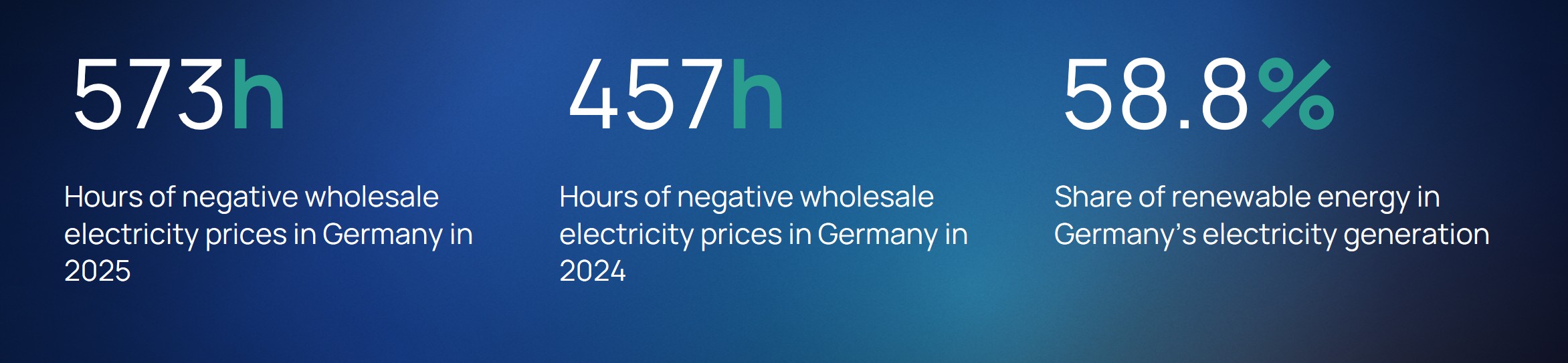
In Germany, wholesale electricity prices were negative for 573 hours in 2025, compared with 457 hours in 2024. At the same time, renewable energy accounted for 58.8% of the country’s electricity generation.¹
¹ Bundesnetzagentur, 2025 Electricity Market Data.
The rapid expansion of renewable generation is increasing the need for storage, flexibility and grid adaptation. It can also reduce the value captured by producers when supply exceeds demand or cannot be fully absorbed by the electricity network.
A power purchase agreement (PPA) can provide visibility on price without necessarily guaranteeing the volumes that will ultimately be produced, injected into the grid and monetised. As a result, the assumptions underpinning a project at launch can evolve significantly over its lifetime.
The question therefore becomes less about the intrinsic quality of an asset and more about its ability to absorb changes in its economic environment.
The critical role of capital structure
This is arguably one of the most important lessons of the current market cycle.
The difficulties recently experienced by certain industry participants demonstrate that risk does not always originate from the assets themselves. It can arise from a mismatch between the evolution of an asset’s economic value and the rigidity of its financing structure.
In many cases, two risks have materialised simultaneously.
The first is microeconomic. Certain production and revenue assumptions have proved less favourable than expected. The multiplication of negative pricing events, grid congestion and production curtailments has, in some cases, reduced the revenues effectively generated by assets. In certain situations, power purchase agreements provided visibility on selling prices, but not necessarily on the volumes ultimately monetised.
The second is macroeconomic. The rapid rise in interest rates has weighed on the valuation of many infrastructure assets and has made refinancing and capital raising significantly more challenging.
Recent developments in Germany illustrate this dynamic. Enerparc entered preliminary insolvency proceedings only months after securing financing facilities of up to €1 billion. ABO Energy announced an expected loss of approximately €170 million for the 2025 financial year, while BayWa r.e. launched a broad transformation programme aimed at strengthening its financial resilience.²
These situations highlight a key reality: asset quality can no longer be assessed independently from its financing structure. In an environment shaped by energy price volatility, changing interest rates and evolving regulatory frameworks, the ability to absorb shocks is becoming an increasingly important driver of resilience.
The question is therefore no longer only which assets to finance, but also how to finance them.
The robustness of the capital structure is progressively becoming as important a performance driver as the intrinsic quality of the underlying infrastructure.
² pv magazine (September 2026), ABO Energy (January 2026), BayWa r.e. (December 2024)
From growth to resilience
For many years, value creation was primarily driven by the ability to develop new projects quickly. Today’s environment introduces an additional requirement: building assets and platforms capable of navigating multiple market cycles.
Achieving resilience requires diversified revenue streams, a balance between contracted revenues and market exposure, disciplined leverage management and financing structures aligned with the different stages of an asset’s lifecycle.
The energy transition cannot be financed with a single tool. Some companies require equity capital to accelerate growth. Others need debt solutions to support a construction phase, address temporary financing needs or prepare for long-term refinancing.
Equity and debt should therefore not be viewed as competing approaches. Their complementarity enables capital structures to be aligned with asset maturity and changing market conditions.
Towards a new value creation cycle
Recent difficulties do not call into question the investment needs associated with the energy transition. Rather, they mark the end of one cycle and the beginning of another.
Future value creation will depend less on the deployment of generation capacity alone and more on the ability to optimise interactions between generation, consumption, storage and new electricity uses.
In this new phase, projects can no longer be assessed solely through a technological or operational lens. The strength of their revenue models, the quality of their financing structures and their ability to withstand different market scenarios will be equally important.
The energy transition continues to offer considerable opportunities. However, it is entering a more demanding stage of maturity, where asset quality, business model resilience and financing flexibility are becoming inseparable.
Cédric Lacaze, Managing Partner at RGREEN INVEST, said:
“An asset can remain strategically important for the energy transition while becoming a fragile investment if its financing structure is no longer suited to its economic environment.”